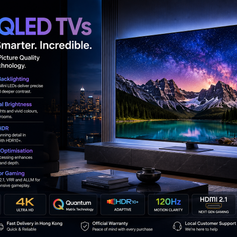
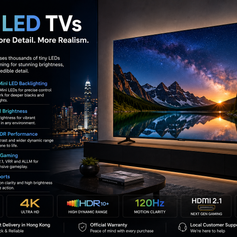
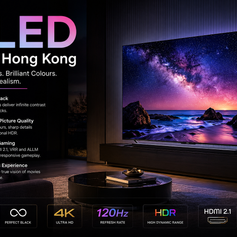
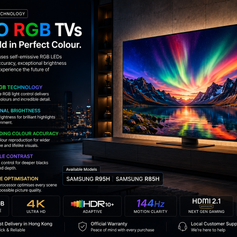
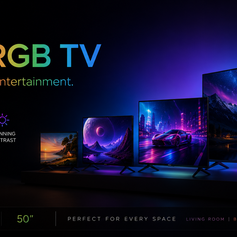
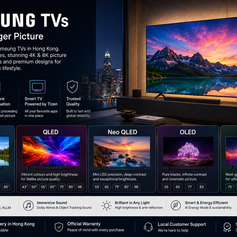
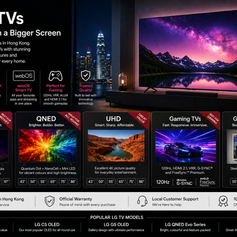
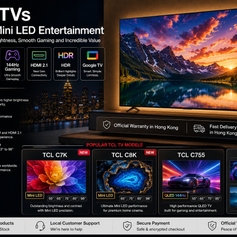
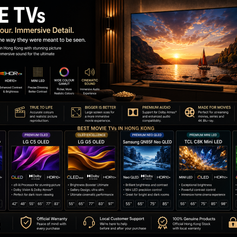

The hardest part of buying a television is not choosing a size — it is the vocabulary: OLED, QLED, Neo QLED, 4K, 8K.
They describe two things only: resolution (how many pixels) and display technology (how the picture is lit). This guide explains each using models and prices we actually hold in stock.
The one-minute version
- Resolution: 4K is the current standard; native 8K content is still very scarce
- Dark-room film watching: OLED — true black, the best contrast
- Bright living room: Neo QLED — Mini LED backlight, the best brightness and dimming control
- Tight budget: Crystal UHD — from HK$2,780 here
- Do not judge gaming performance by the technology name — check the official refresh rate
Resolution: how far apart are 4K and 8K
| Format | Pixels | Total pixels |
|---|---|---|
| Full HD | 1920 × 1080 | about 2.07 million |
| 4K UHD | 3840 × 2160 | about 8.29 million |
| 8K UHD | 7680 × 4320 | about 33.18 million |
4K is four times Full HD, and 8K is four times 4K.
But more pixels does not mean you can see them. At typical Hong Kong living-room distances — 2 metres and beyond — the eye cannot resolve the pixel difference between 8K and 4K. On top of that, native 8K content remains very scarce; the major streaming services and broadcasters still cap at 4K.
So 4K is the practical choice today. There is really only one case for 8K: you are buying 75 inches or larger and you want flagship-tier hardware.
Display technology: the three explained
OLED: every pixel makes its own light
OLED has no backlight. Each pixel emits its own light and can switch off completely, so black really is black.
Strengths: true black, very high contrast, accurate colour, wide viewing angles.
Limits: peak brightness trails high-end LED sets; it costs more.
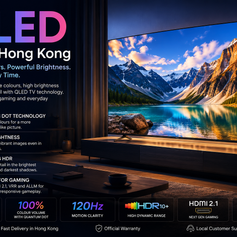
QLED: quantum dot over an LED backlight
QLED is an LCD architecture lit by a backlight, with a quantum dot layer added to raise colour volume. The pixels do not emit light themselves, so black level depends on how well the backlight is controlled.
Strengths: high brightness, vivid colour, strong in bright rooms.
Limits: it cannot reach OLED's true black.
Neo QLED: QLED with a Mini LED backlight
Neo QLED is Samsung's premium QLED, replacing the backlight with far smaller and far more numerous Mini LEDs that can be divided into many independently controlled zones.
What that buys: more precise local dimming, better contrast, less blooming around bright objects, finer brightness control.
And a fourth: Crystal UHD
This is Samsung's entry line: an LED-LCD panel with no quantum dots and no Mini LED. Picture quality trails the three above, but it is the cheapest way in — ours start at HK$2,780 for a 43-inch.
For everyday drama, streaming and broadcast television, Crystal UHD is already enough.
Technology at a glance
| Technology | Core strength | Best for | Our lowest entry price |
|---|---|---|---|
| Crystal UHD | Price | Everyday viewing | HK$2,780 (43") |
| QLED | Brightness and colour | Bright rooms | HK$2,980 (43") |
| Neo QLED | Mini LED local dimming | Bright rooms, gaming | HK$5,980 (55" QN80F) |
| OLED | True black and contrast | Dark-room film watching | HK$6,480 (55" S85F) |
Look at that last row: OLED starts at HK$6,480, only HK$500 above the entry Neo QLED. That gap is much smaller than most people assume.
The Samsung 2025 models we stock
The three OLEDs
- S95F 77" — HK$48,980, in stock. The OLED flagship, strongest on brightness and colour.
- S90F 65" — HK$10,980, in stock. Upper mid-range, the most balanced value.
- S85F 55" — HK$6,480, in stock. Entry OLED, with the same true black and contrast.
The three Neo QLED 4K sets
- QN90F 75" — HK$31,980, in stock. High-end Neo QLED, best brightness and HDR.
- QN85F 55" — HK$6,280, in stock. Mid-range, balanced for film and gaming.
- QN80F 55" — HK$5,980, in stock. Entry Mini LED, best value on large screens.
All sizes are in the OLED range and the Neo QLED range.
8K: we have exactly one
To be straight about it: there is one 8K television in our whole catalogue.
- Neo QLED 8K QN800C 65" — HK$9,980, in stock. A 2023 model.
Is it worth it? Not because it is 8K — because it is a Mini LED flagship for under ten thousand dollars. If you are buying for the resolution, re-read the section above: at normal viewing distances you cannot resolve it.
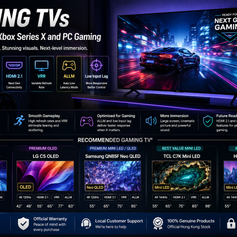
Gaming: do not judge by the name
Plenty of guides say "OLED and Neo QLED are both good for gaming". That is too absolute.
For example, Samsung's official specification lists the QN70H Neo QLED (2026) as 50Hz native with DLG 120Hz. DLG trades vertical resolution for refresh rate; it is not a native high-refresh panel.
So "Neo QLED means good gaming" does not hold. Before buying, check two fields on the official specification:
- Refresh rate — read the native figure, not just the "up to XXXHz" number
- VRR — whether variable refresh rate is supported
If you are not sure, WhatsApp us with the model number and we will look up the official specification.
How to choose
Choose OLED if:
- You mostly watch in a room where you control the light
- You want true black and the highest contrast
- You care about colour accuracy and wide viewing angles
Choose Neo QLED if:
- Your room is bright with a lot of windows
- You watch sport, variety shows, or a lot of daytime television
- You game — though still verify the refresh rate model by model
Choose Crystal UHD if:
- Budget comes first
- You mainly watch streaming, broadcast TV and everyday programming
- It is for a bedroom or a smaller flat
Frequently asked questions
Is OLED better than QLED?
It depends on the room. OLED has better black levels and contrast; QLED is brighter and performs better in a bright room.
Is 8K better than 4K?
On resolution yes, but native 8K content is still very scarce. For most people 4K strikes the best balance between picture quality and available content.
Is Neo QLED better than QLED?
Yes. Neo QLED uses a Mini LED backlight, which improves local dimming and brightness control over standard QLED.
Which technology is best for gaming?
You cannot judge by the technology name alone. Within Neo QLED there are models with native high refresh rates and models officially listed at 50Hz native plus DLG. Check the refresh rate and VRR fields on the official specification before buying.
How much more is QLED than Crystal UHD?
At 43 inches, Crystal UHD is HK$2,780 and QLED is HK$2,980 — a difference of HK$200. The quantum dot advantage shows most in a bright room.
Any questions
WhatsApp +852 9847 9793 (11:00–19:00). Tell us how bright your room is, how far back the sofa sits and what you mostly watch, and we will narrow it to two or three options so you are not checking model numbers yourself.
Our warranty
- Sourcing: not local Hong Kong retail stock — international version, warranty provided by us.
- Warranty: free on-site inspection and repair within three years. Replacement parts are quoted separately — we quote first, and only proceed once you confirm.
- Installation: on-site installation available, quoted by address.
- Full terms: see the delivery and warranty terms.