


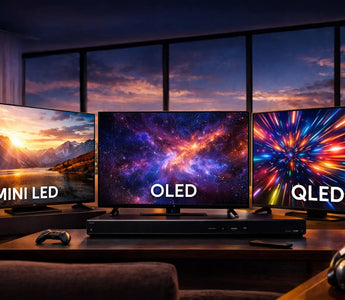
Mini LED, OLED and QLED: understand the overlap
QLED, Mini LED and OLED are not three mutually exclusive categories. QLED describes LCD colour technology, Mini LED an LCD backlight, and OLED self-emissive pixels. A TV can be both QLED and Mini LED.
This is a technology and specification comparison. Choose full models by lighting, static-content use and connections and compare actual quotes and required features.
If you are already shopping for a new television, you can also explore our guides to the best Mini LED TVs in 2026 and the best 65 inch TVs in 2026.
Quick Answer: Mini LED vs OLED vs QLED
Start with the principles, then compare actual models:
- OLED: self-emissive pixels can turn off for black.
- Mini LED: smaller LCD backlight emitters; dimming depends on zones and control.
- QLED: quantum-dot LCD colour technology that can coexist with Mini LED.
No technology label guarantees value; compare same-size models, quotes and required features.
Mini LED vs OLED vs QLED Comparison Table
| Use | Candidates and trade-offs |
|---|---|
| Dark-scene movies | OLED pixels can turn off; also assess HDR, reflections and static content. |
| Bright room | Compare actual brightness and reflections on Mini LED LCD or other models; QLED is not a brightness guarantee. |
| Gaming/PC display | Confirm 4K inputs, VRR, ALLM and static-image use per SKU rather than by panel alone. |
| Budget | Compare full-model features and quotes at the same size; QLED and Mini LED overlap. |
Browse candidate models by family
Use collections and product pages as navigation; confirm quotes and supply for the selected full SKU.
OLED, Mini LED, Neo QLED and QLED collections can overlap; do not add category counts as distinct inventory. OLED · Mini LED · Neo QLED · QLED
Neo QLED is Samsung’s family combining quantum-dot LCD with Mini LED backlighting. It shares a backlight approach with other Mini LED TVs, but panels, zones, processing and gaming vary; it is not merely a name change for identical specifications.
Delivery and installation within Hong Kong only.
What Is OLED?
OLED stands for Organic Light Emitting Diode. Unlike LED-based TVs, OLED panels do not use a backlight. Instead, each pixel produces its own light and can switch off completely.
OLED can switch black pixels off individually. The picture seen at home still depends on reflected room light, near-black handling, HDR and the selected mode.
OLED Advantages
- Black pixels can turn off for dark-scene contrast.
- Accuracy, shadow detail and viewing angles remain model/mode dependent.
OLED Disadvantages
- Compare quotes at the same size and tier.
- Consider reflections and actual brightness in daylight.
- Prolonged fixed logos, HUDs or desktops can cause uneven ageing.
OLED is a dark-scene movie candidate, assessed alongside typical content and room lighting.
What Is Mini LED?
Mini LED describes smaller LCD backlight emitters, not self-emissive pixels. Emitter counts, zones and control vary by model.
Smaller emitters can support zoned dimming, but HDR and blooming depend on zones, algorithms, panel and content; superiority over every conventional LCD is not automatic.
Mini LED Advantages
- Consider for bright-room and HDR use.
- LCD does not use the same organic pixels as OLED; this is not a lifetime guarantee.
- Confirm actual contrast and brightness by full model.
Mini LED Disadvantages
- LCD black levels depend on the panel, dimming and content; assess the full model
- Some blooming can appear around bright objects on dark backgrounds
- Price depends on size and tier; QLED and Mini LED can describe the same TV
For daylight or sport, compare reflections, source frame rate and motion settings. Candidate models: best Mini LED TVs in 2026
Samsung's 2026 Mini LED line-up
These links are Samsung candidates; confirm specifications, quotes and supply by full model.
Compare same-size M75H, M80H and QN70H backlighting, native/maximum input and required functions before pricing. M75H · M80H 55-inch · QN70H · M80H 65-inch · M80H 75-inch
Do not recommend a QLED-to-Mini LED upgrade from an unconfirmed price gap; the categories can overlap, so compare actual models and features.
What Is QLED?
QLED commonly refers to quantum-dot LCD; its backlight can be conventional LED or Mini LED, confirmed by model.
Colour, brightness and pricing vary by model. QLED does not guarantee a cheaper or brighter result than every OLED or Mini LED.
QLED Advantages
- Quantum dots can support a broader colour range.
- Compare size, brightness, dimming and quotes per model.
QLED Disadvantages
- QLED alone does not describe physical dimming zones.
- It can also be Mini LED, so a fixed third-place ranking is invalid.
- Black levels and blooming depend on panel and backlight control.
Use QLED as a colour-technology label, then confirm its backlight, required functions and same-size price.
Mini LED vs OLED vs QLED: Key Differences
1. Brightness
Compare brightness with matching modes, windows and duration, plus reflections in daylight. Mini LED alone does not establish a winner.
QLED includes different backlight tiers; OLED varies in brightness and coating too. Compare actual models.
2. Contrast and Black Levels
OLED black pixels can switch off individually because each pixel can turn off individually. Assess shadow detail, HDR, reflections and settings on the exact model.
LCD dimming varies by zones and algorithms. QLED and Mini LED overlap, so they cannot form a fixed second/third-place hierarchy.
3. Color Performance
Gamut, colour volume and accuracy are different measures; quantum-dot or OLED names do not guarantee more natural or accurate colour.
4. Gaming
For gaming, confirm native/maximum input, VRR, ALLM and HDMI routes for the SKU. Assess fixed HUD use on OLED and response/latency on LCD rather than choosing by name alone.
5. Price and Value
Size, year, tier and offers affect pricing. Compare actual quotes and essentials instead of a fixed price ladder for overlapping categories.
Which TV Technology Is Best for Movies?
For films in a dim room, OLED is a useful candidate because black pixels can switch off. Shadow detail, HDR and reflected light still require an exact-model comparison.
However, Mini LED can also be excellent for movies if you watch in a brighter room or want stronger HDR impact.
Which TV Technology Is Best for Bright Rooms?
For a room with large windows or strong ambient light, include Mini LED candidates and compare their actual brightness, reflections and seating angles with the OLED and other LCD options. The technology label alone does not determine daytime visibility.
For daylight, compare actual brightness and reflections on QLED, Mini LED and OLED models. For dark-room films, OLED’s pixel-level black control is useful; HDR, shadow detail and static-content use still matter.
Which TV Technology Is Best for Gaming?
For gaming, the answer depends on your priorities:
- OLED: consider black levels, pixel response and fixed HUDs.
- Mini LED LCD: assess reflections, brightness, dimming and gaming inputs.
- QLED: establish the backlight tier before checking console/PC functions.
For gaming, first verify the required frame rate, VRR and HDMI route. Then compare actual HDR brightness and reflections for daylight use, or OLED’s pixel-level blacks for dark-room use, while considering fixed HUD content.
Who Should Choose OLED?
- Movie lovers
- Home theater users
- People who watch TV mostly at night
- Buyers who want the best contrast and black levels
Who Should Choose Mini LED?
- Bright-room candidate, subject to reflections and brightness.
- For sport, compare source frame rate and motion settings.
- For substantial fixed HUD use, compare LCD options and gaming functions.
Who Should Choose QLED?
- For everyday viewing, compare budget, size and apps.
- Check backlighting and gaming before assessing value.
Final Verdict: Mini LED vs OLED vs QLED
There is no single best TV technology for everyone.
Assess dark-scene black levels, daylight reflections, gaming inputs and budget separately; names help form a candidate list.
If you want the simplest recommendation:
- Dark-scene movies: start with OLED candidates.
- Bright rooms: compare actual brightness, reflections and LCD dimming.
- Budget or gaming: compare same-size full SKUs and quotes.
Decided? Here is what we have
For dark-scene movies, compare the OLED TV collection by full model, HDR, reflections and static-content use. Confirm current supply and quotes separately.
For bright-room viewing, sport and HDR, compare actual brightness, reflections and dimming in Mini LED TVs and Samsung Neo QLED TVs. Confirm each required size and full model.
For everyday viewing, compare QLED TVs by size, backlighting, apps and actual quote.
Compare features and quotes for same-size full models before buying; no label guarantees the best long-term value.
If you want real buying recommendations after understanding the technology, check out our Best Mini LED TV 2026 guide and our Best 65 Inch TV 2026 roundup.
Frequently Asked Questions
Is Mini LED better than OLED?
For daylight, compare actual brightness and reflections on the full models. For dark scenes, OLED’s per-pixel light control benefits black levels; also consider HDR, static content, size and price.
Is QLED better than OLED?
OLED black pixels can turn off. QLED is an LCD colour category whose brightness, dimming and price vary; it is not universally brighter or cheaper.
Is Mini LED better than QLED?
They can coexist: Mini LED describes backlighting and QLED quantum-dot colour. Compare actual dimming and full models, not mutually exclusive labels.
What is the difference between Neo QLED and Mini LED?
Neo QLED is Samsung’s quantum-dot LCD/Mini LED family. The backlight approach overlaps other Mini LED TVs, but specifications and performance remain model-specific.
Which TV technology lasts longer?
Static-content ageing risk is different from overall lifespan. OLED needs care with prolonged fixed images; LCD parts can also age or fail. Technology names alone do not establish the longest life.
Recommended Reading
Buying from Elechid: what happens next
| Service | Arrangement |
|---|---|
| TV cover | Three years of shop inspection and repair labour; parts quoted separately and fitted after approval. |
| Delivery/installation | Provide size, floor, lift, wall and stand/wall-mount requirements for a quote; follow the existing terms. |
| Kwun Tong premises | Stock and collection only; no viewing or side-by-side demos. Contact us before collection. |
Ask us on WhatsApp Full warranty & delivery terms
Elechid delivers and installs within Hong Kong only.
Browse TV Technology in Hong Kong
Compare the latest TVs in Hong Kong by size, brand and use case, or shop directly by Mini LED, OLED, QLED and Neo QLED.
If gaming or sport is your priority, compare our gaming TVs and sport TVs. For room planning, see the TV size guide for Hong Kong living rooms.
Turn the panel comparison into a same-size shortlist
For a useful quote, put two or three complete models in the same screen-size bracket. Record room lighting, daily fixed-logo or desktop use, required apps and the source’s actual output mode. Leave unsupported brightness or latency figures blank instead of filling them with a category-wide assumption.
- OLED candidate: the Samsung S90F size and regional-version guide explains why one series name does not confirm every panel.
- Mini LED candidate: the QN70F, QN80F and QN85F comparison narrows the question to full models rather than treating all QLED TVs alike.
- Screen-size decision: use the TV size guide for Hong Kong rooms before comparing quotes.
For a reception desk, menu board or other business display, state the daily operating hours and fixed-content pattern. A domestic TV listing does not establish commercial-use suitability or warranty coverage. Confirm those terms before ordering rather than relying on a Mini LED or OLED label.
Selection notes updated 23 October 2026. Manufacturer specifications, calculated examples and actual tests are distinct; confirm the exact supply version before buying.


